Dejar un mensaje
Si está interesado en nuestros productos y desea conocer más detalles, deje un mensaje aquí, le responderemos lo antes posible.
A bridge stone cutting machine should be chosen around your real jobs, not the longest specification list. A fabricator may cut slabs accurately yet still lose time when operators must reposition parts for sink openings, mitres, curves, or edge details. Those extra touches create labor cost, handling risk, and avoidable rework.
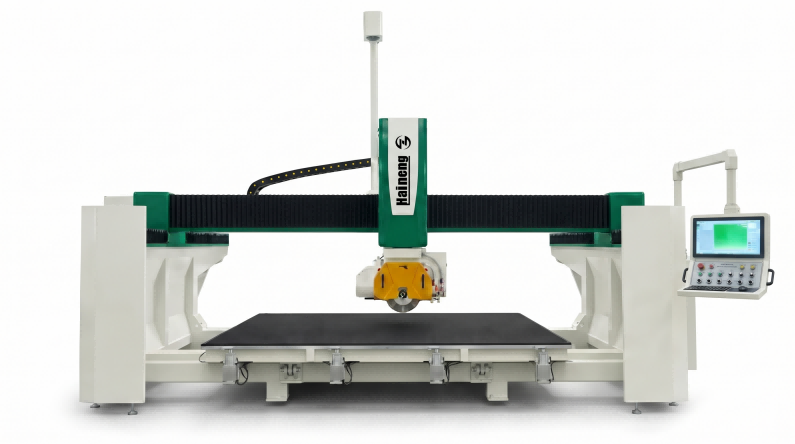
Start with the mix of work you want to keep in-house. A shop producing simple rectangular granite pieces may only need dependable straight cutting. A countertop fabricator working with quartz, porcelain, marble, or shaped kitchen tops needs a broader workflow: slab layout, angled cutting, milling, drilling, part handling, and repeatable programming.The point is not to buy every feature. It is to select the features that remove the costly bottlenecks in your workshop.
1. Confirm the Cutting Envelope Before Comparing Price
First, compare maximum cutting length, width, and thickness with the slabs and finished parts you actually sell. Do not stop at the table size. You also need enough clearance for clamping, tool travel, and safe loading. The HTQ-500CNC/5+1A is specified for cutting up to 3,500 × 2,000 × 120 mm and chamfering up to 3,500 × 2,000 × 80 mm; its rubber-faced table is also 3,500 × 2,000 mm.
These figures may suit many countertop and architectural-stone jobs, but they are not a substitute for reviewing your own drawings. List your ten most frequent jobs and five difficult jobs. Include material, thickness, finished size, openings, edge treatment, and annual volume. Ask each supplier to confirm which operations can be done in one setup.
Also check the blade range against the material you process. A 350–500 mm blade range gives flexibility, but quartz, granite, marble, and porcelain need different blade specifications, feeds, water management, and cutting strategies. A credible supplier should explain the process for your material, not simply say that the machine can cut everything.
2. Choose Axis Capability Based on the Product Mix
The number of axes matters only when it reduces real handling. With a C-axis rotation range of 0°–360° and an A-axis tilt range of 0°–90°, the quoted HTQ configuration is designed for vertical, horizontal, inclined, and chamfer cuts. Its stated applications include curves, circles, milling, profiling, holes, L-shaped countertops, basins, and four-sided under-mount sink work.
Ask yourself which of these operations happen every week. If operators frequently mark angles, turn parts, transfer pieces to another machine, or correct inside corners by hand, multi-axis motion can address a real bottleneck. If orders are mostly repeated straight rectangles, a simpler solution may be easier to train and justify.
Request a demonstration using a drawing similar to your own work—not a basic square sample. A useful trial includes a sink opening, an inner corner, a chamfer or mitred edge, and one curve. Watch the whole sequence: program creation, tool selection, material holding, machining, and unloading. The right machine is the one that completes your repeat work with fewer unnecessary touches.
3. Evaluate the Spindle and Tooling as Carefully as the Saw Blade
For countertop shops, the spindle often determines whether a bridge saw is only a cutting station or a more complete fabrication cell. Sink cut-outs, faucet holes, curved openings, inside corners, and profile work can otherwise require another machine and another operator. The HTQ-500CNC/5+1A is quoted with a 7.5 kW electric spindle rated at 24,000 rpm and an automatic tool-setting gauge. The supplied material positions this spindle for drilling, curve cutting, corner work, and milling.
Do not buy based on rpm alone. Ask which milling tools are included, which are optional, and which packages are recommended for each material. Confirm calibration steps, water or coolant requirements, tool-life expectations, and training requirements. For quartz or porcelain, request a sample process for your thickness range and finish standard.
The operational goal is fewer hand-finished corrections. A programmed basin opening or inner corner can improve repeatability, but only when tooling, drawings, slab support, and operator training are all controlled. Ask to see a finished part, not just the machine in motion.
4. Use Camera Layout and Measurement to Protect High-Value Slabs
A wrong cut can waste an entire premium slab, so layout tools deserve close attention. The supplied HTQ configuration includes camera-based photo layout, an automatic thickness probe, and a vein-matching function. The quotation describes using a slab image to position the drawing and using the probe with that image to calculate slab dimensions.
This can help a programmer review vein direction before cutting, position openings away from an undesirable area, and align adjacent pieces more deliberately. It is especially relevant for natural stone, book-matched work, and projects with several components from one slab. Automation does not replace judgment: the operator must still inspect cracks, defects, grain direction, and the final drawing.
During evaluation, ask to see the full workflow from photo to drawing placement to first cut. Can the operator adjust the layout manually? Are offcuts shown clearly? Can job layouts be stored? How does the system respond when a slab is not flat? Answers to these questions show whether a camera is a daily production tool or a brochure feature.
5. Verify Holding, Handling, and Loading in Real Conditions
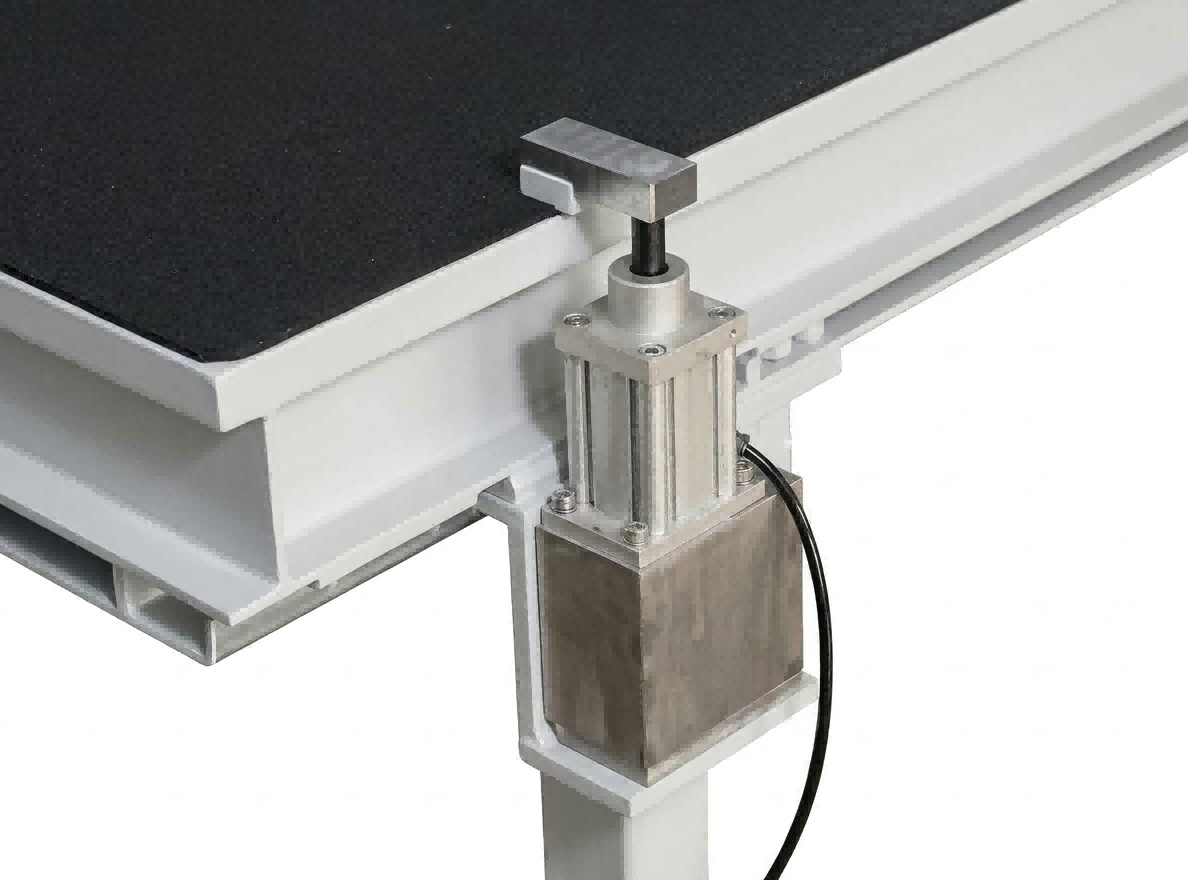
Fast motion is not useful if a slab is unstable or a cut part interferes with the next tool path. The HTQ-500CNC/5+1A quotation lists vacuum cups with a stated lifting capacity up to 200 kg, automatic clamping for milling work, and a table that can tilt to 85° for loading. The documentation says vacuum cups can move a slab when a planned blade path conflicts, while side cylinders press the plate during milling and retract afterward.
Before purchase, confirm the number and positions of the cups, the supported thickness and weight range, the vacuum maintenance routine, and the machine’s response to low vacuum. Ask for a demonstration involving a narrow, irregular, or cut-out part—not only a full slab. Review how thin pieces are supported during milling.
Also map your own material flow: slab rack, lifting equipment, loading, processing, unloading, inspection, and packing. A tilting table only improves productivity if it fits the crane, operator reach, and safety procedures in your plant.
6. Review Controls, Utilities, and Service—Not Only Machine Hardware
A bridge saw is a long-term production asset. Review the drive system, controller, utilities, and after-sales support before you sign. The quoted HTQ configuration includes linear guides on X, Y, and Z; rack-and-gear transmission on X and Y; a ball screw on Z; an industrial computer with touch screen; RTCP CNC control and CAM software; and automatic lubrication. It also lists a 22 kW five-axis permanent-magnet main motor, 35 kW total power, and water consumption of 2 m³/h.
The supplier states that the permanent-magnet motor can adapt output to workpiece thickness and may save up to 40% power. Treat that as a supplier claim, not a universal operating result. Request consumption evidence for a job similar to yours before putting it into an ROI calculation.
Plan the installation as carefully as the machine choice. The quotation gives a footprint of 5,750 × 4,150 × 3,450 mm, an approximate weight of 5 tonnes, and shipment of the main part as a whole in an HQ container. Check foundations, electrical capacity, water management, unloading, maintenance clearance, commissioning, spare parts, response time, and operator training. Confirm what remote monitoring, software upgrades, and support actually include.
7. Buy on a Trial Job and Total Cost, Not a Brochure Promise
Send supplier one of your real drawings before making a decision. Provide the material, thickness, tolerance, openings, edge profile, and any vein-matching requirement. Then ask for the full workflow: loading, layout, programming, cutting, milling, unloading, and inspection. Record the acceptance criteria before shipment.
Compare total cost, not just FOB price. Include tooling, freight, foundation work, electrical and water preparation, installation, training, consumables, recommended spare parts, support, and expected labor changes. A lower machine price can cost more if it adds handling or leaves the team without support. A more capable CNC bridge saw earns its cost when it removes repeated manual work on frequent, profitable jobs.
For fabricators processing marble, granite, porcelain, and quartz countertops, the HTQ-500CNC/5+1A merits evaluation where shaped work accompanies straight cutting. Its specified envelope, multi-axis head, spindle, photo layout, measuring probe, vacuum handling, clamping, tilting table, and lubrication address common sources of rework. The right machine should make your production calmer and more repeatable—not more complicated.
FAQ
1.Is a 5-axis bridge saw necessary for every workshop? No. It is most valuable for frequent mitres, chamfers, curves, openings, shaped edges, and complex countertops.
2.What should I send before requesting a quote? Send slab size, material, thickness, drawings, output target, utilities, lifting equipment, and the operations required in one setup.
3.What should I verify at acceptance? Confirm cutting envelope, axes, spindle, camera/probe, holding systems, software, safety devices, sample-part quality, training, and service process.
No.7, Jinyuan Road, Wuli Industrial Park, Jinjiang, Quanzhou City, Fujian Province, China
Correo electrónico : Anyth@anythmachine.com
Teléfono : +8613757603958
Teléfono : +8613586156380


Derechos de autor © 2013-2026 Quanzhou New Haineng Stone Machinery Co.,Ltd.. Reservados todos los derechos.
 Red IPv6 compatible
escanear a wechat




 English
 français
 Deutsch
 русский
 português
 العربية
 Türkçe
 Polski
 Indonesia